
Pages

Showing posts with label church planters. Show all posts

Monday, August 13, 2012

The London Olympics Got It Right! (A Leadership Principle)

One of the things I have been most impressed about (and there have been many) watching the London 2012 Summer Olympics is the overt thread of belief and optimism about the next generation.


During the Opening Ceremonies, when it came to the infamous torch lighting pomp and circumstance, often awarded to past greats and legends, they took a more holistic approach. I loved how David Beckham was visible but not even in the building, then the legendary runner carried the torch in to the stadium, through 500 construction workers (Average Joe's and Jane's) who built the facility.

Once the torch entered the stadium it was passed to 7 members of the Next Generation who each took a turn as they circled the stadium. Once they made it around, they stopped and handed the torch to 7 past legends (sponsors) in their particular sport. What a great way to honor those who have gone before them and paved the way for them.

Then... in an unexpected twist, the sponsors handed the light back to the young athletes as if to say, "The future is not ours to carry... its your turn now!" At this, the future athletes then ran past the 10,000 current olympians and made their way to the center where they, together, lit the torch. Which was made up of the 204 individual nation's copper bowls.

As I sat on my couch watching the cauldron illuminate, I couldn't help but say out loud: "They got it right!!! They trusted the next generation with the most important part!!!"

What We Can Learn:

The symbolism built into the Opening Ceremonies that night contains a powerful message for everyone of us who are leaders in anyway today. Here are a few key applications that jump out at me...

1. It is necessary and right to honor those who go before us.
     I am a HUGE proponent of giving honor to whom honor is due. There is a generation who paid a great price for the life and opportunities we have. We must never forget to honor them every chance we get. We stand on their shoulders. We reap where they sowed. We have success where they had struggle. Thank you older generations for the price you paid for us. We are better because of you.

2. It is right to honor those who sacrifice and serve behind the scenes.
     I love that the construction workers were invited in to the celebration. So often, those who sweat and bleed and sacrifice behind the scenes never get invited in when the vision is complete and the celebration happens. What can we do to honor those who serve our vision faithfully behind the scenes?


3. It is right to trust the young generation with the Important Stuff, not just the trivial stuff.
     When it came down to the actual lighting of the torch with 1 Billion (that's 1,000,000,000) people (1 out of every 7 people alive on planet earth today) watching, they didn't relent with their belief in the next generation.
     Too often, we in leadership circles, have been guilty of saying we believe in the young generation, saying we trust them, saying we want to empower them, but then when it comes to the big moments, we hold on to the ball.
     If 7 young people can successfully light the Olympic flame in front of 1 Billion people, it probably is conceivable to think the young leaders in our organizations can carry more than we think they can.

PERSONAL STORY ::
     Once upon a time, I was a young leader, bursting with vision and potential and leadership. What I wanted more than anything was for someone in the older generation to give me a shot. When that shot didn't come, I graciously took my talent, energy, ideas and potential and went somewhere else.
    Today, I am so grateful to lead an organization built on empowering young leaders. There is no greater joy for me today then to create opportunities that develop and stretch young leaders and make them better and stronger. I am committing the rest of my leadership life to empowering young leaders and giving ministry away!
     At Next Level Church, we're not waiting for them to be perfect. We're trusting them now. What we're discovering is, when given true belief and opportunity, they rise to the occasion. And even when they fall short of the mark, they're amazingly thankful and teachable because of the chance we were willing to take.
     In conclusion, I can't think of a downside to empowering the young generation. Thank you London 2012 for getting it right and leading the world into a new day! May we leaders follow behind you.

#AddingValue

@MatthewKeller
Monday, March 19, 2012

Dan Cathy interviewing Seth Godin! (Two of my Heroes in One Place!)

Dan Cathy, CEO of Chik-fil-A is definitely a Business Leader I admire & seek to learn from. (I actually have the privilege of sitting in a 60 minute Q and A a few years back... amazing!)

In this 4 minute clip, he is interviewing Seth Godin, who is a personal hero in the realm of marketing for me!

Enjoy...

Adding Value...

@MatthewKeller

Monday, May 23, 2011

The Power of Saying "NO" - A New Leadership Article by @MatthewKeller

     I was recently reminded of the power of saying "NO" in a book I'm reading called, Rework. In it, the authors, Jason Fried and David Heinemeier Hansson make the statement:

               "It's easy to say yes. Yes to another feature, yes to an overly optimistic deadline,
               yes to a mediocre design. Soon the stack of things you've said yes to grows so 
               tall you can't even see the things you should really be doing."

     When I read this, I couldn't help but think of so many leaders of church plants and churches. In our desire to build a great church and win people to our cause, too often we find ourselves saying "YES" to things we really should be saying "NO" too.

1.  Saying NO is never easy.

     I'm not going to deceive you into thinking that telling people no is fun or easy or a flippant thing in any way. Just the opposite, it's actually really hard! Especially when your church or organization is small! The last thing in the world you want is for someone to leave because you wouldn't care for their legitimately "good" idea.
   
     However, if we don't protect and fight for the purity of the culture we're trying to create in our churches, we'll end up watering down who we are to such a degree that in the end it does more harm than good.

2.  Saying NO won't make people happy.

     Inevitably, when we say no to someone's "good" idea, someone's feelings will get hurt. People won't always understand why we're making the decision we're making and some will leave mad. This is just a function of the leadership journey. As a leader, making the right decision for your organization is what you get paid to do, and it times it will come with a price.

    However, I have found that most people are pretty understanding when they know the why behind our decision. Not always, but a lot of the time. When we share our logic and heart, people can accept that and move on. It has been my experience that people don't want to be right as much as they simply want to be heard. As leaders, it's our job to listen sincerely, explain our perspective and then make the wise decision for the organization that we ultimately lead.

3.  Saying NO protects you, your family and your organization.

     As our organization has grown, my responsibility to say NO has increased significantly. Because let's face it, in a bigger organization, there's money, facilities and the perception that we could accommodate more "good" things.

     But I have had to learn the art of saying NO in order to protect my family, my schedule, my time, and my energy. Yes I'm a leader, but I'm also still a human being. And I must be wise enough to understand that I'm the only guy who can care for my wife (well, there are others, but we'd all agree, we don't want that!!!) I'm the only guy who can be dad to my 2 boys, and I'm the only guy who can show up every weekend and share life-giving, vision oriented, engaging messages that allow the Holy Spirit to change lives. 

     If I'm not prioritizing those things, then I'm not doing my job. That IS my #1 Priority.

4.  Saying NO allows you to stay focused on what you do best.

     At the end of the day, when you say NO to something "good" you position your organization, your staff and your teams to focus on the best.

     There's something freeing about the word NO. Unfortunately, far too many leaders use it far too infrequently.


Application:  

     If you HAD to identify 3 things that you MUST say no to, what would they be? In the next 24 hours,  do the hard but right thing and say NO to them. In the end, you know you'll feel better about it!

Just a thought,

Matt Keller

Monday, May 9, 2011

Do you buy the book? A 90 second leadership challenge for the rest of us...

I've had an interesting observation recently at events where I've been speaking...

Surprisingly few people buy the books.

First, a couple confessions:

1.  I'm an avid reader. I read 4 to 6 books at a time, in different categories, and with different reasons in mind. Therefore, I'm always on the lookout for new content that I can get my hands on. I subscribe to the idea that, "The more you put in, the more sticks and the more you have to give later." I'm a teacher. It's just who I am.

2.  I'm an author. I am willing at this point, to concede the fact that at several of these events recently I've had one of the books that's available for sale.

Now back to the question:

Why are so many people moved in a teaching session, and yet so few want to add to their learning beyond the event?

A Few Possible Answers:

1.  They think they've already learned all the author has to share.

2.  They aren't willing to commit to extending their learning.

3.  They weren't really that impacted by what was taught in to begin with.

4.  They have the wrong perspective. 

One of my leadership Buzzwords is Teachability. It's something that I've made a life's purpose; To be teachable. It's something I think there's just too little of in leadership circles.

I am convinced that so often, we attend a conference, leadership event, a class, or even just a church service and something inside us wells up right at the moment where we're challenged to change. However, instead of leaning in to change, we actually lean out just far enough for us to miss the opportunity to become something greater in our life or leadership.

So what about you? When was the last time you "bought the book" or "took the step" or "made the change?" Are you willing to lean in or are you more likely to lean out?

Just a thought...

Matt Keller

Friday, March 11, 2011

Ready or Not, Here it Comes!!! - Part 3 (Repost)

Today we finish an article on How to Slay the Monster of Sunday. I would love to hear your feedback. Feel free to leave a comment,

Thanks,

Matt Keller


Taming the Monster of Sunday

(Help for Pastors under Pressure)


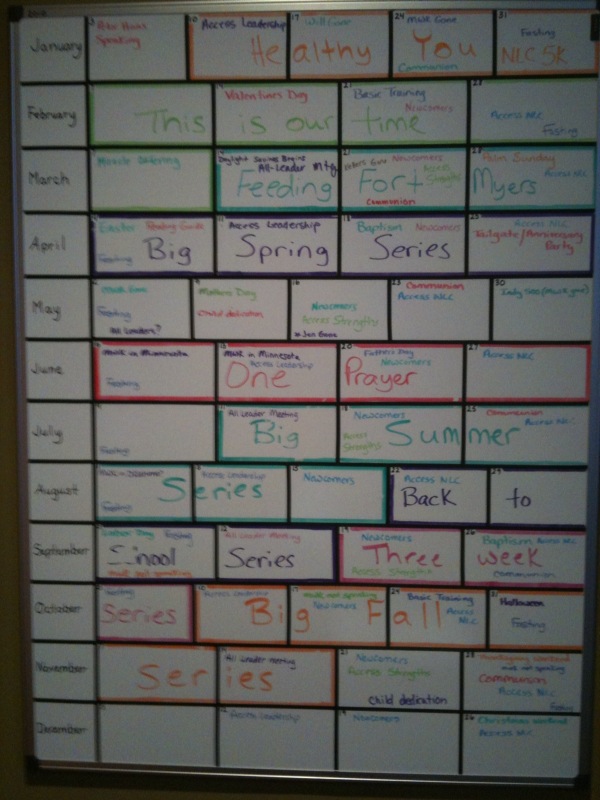
7. Use a Wall of Sundays to organize your thoughts. The way to see the long-range rhythm of your year is to have a place to put your creative thoughts when they come to you. We started doing this about 3 years ago and our wall of Sundays has become life to me and our team. I have to see things big and as a team, we need to plan ahead.

Here’s a picture of our most current Wall-of-Sundays.

8.  Practice your messages. Some pastors will say they want to "make sure the emotion of the moment comes through on Sunday," or that "you can't rehearse the anointing." But I think that's just an excuse. You wouldn't say that to your worship team. If we want our worship team to rehearse and come prepared, then so should we. It took me awhile to get used to practicing my messages out loud, but for me, there's no better way to actually get the content into your mind and spirit.

I can't tell you how many times I will be practicing my message in my home office on Saturday night and hear myself say something a certain way. In those moments, I'll actually stop and say out loud, "That didn't sound right. Don't say it that way again." ThenI’ll go back to the beginning of that section or story and practice saying it a different way.

By the way, for those of you who do multiple services, remember, first service is not your practice. We can either sweat in preparation or bleed in battle. I don't know about you, but I would rather sweat in preparation.
The Result:

As a communicator who now speaks 150 - 200 times/year as well as writes consistently, it is vital that I have a sustainable rhythm for message preparation and content. There's no way I could live out my calling otherwise.

If you're a communicator, begin to strategically work on developing your own rhythm. It will serve you well for years to come.

Wednesday, March 9, 2011

Ready or Not, Here it Comes!!! - Part 2 (Repost)

On Monday, we began talking about the burden of "Every 7 days, ready or not" in the ministry...

Here's part 2...


Taming the Monster of Sunday - Part 2

(Help for Pastors under Pressure)


4.  Learn to write to 80%. When I say that I'm 4 to 6 weeks ahead in message prep, this is what I mean. I have a goal to have the main points, verses and illustrations laid out (or 80% of the message) weeks in advance. This gives me peace of mind knowing that on any given week, I'm simply microwaving the message up to 95% on Monday morning, rather than trying to start from scratch every week.

5.  I write on Mondays. The common theme for most pastors is to want to jump in front of a bus on Mondays, but I have found that if I can get in the zone and think of it as a continuation of the day before, I'm actually capable of some pretty amazing creativity. The benefit of locking in my message on Monday is:
  • I feel extremely productive. Doing what I do best on Mondays, rather than all the to-do list stuff, makes me feeling like a million bucks and sets me up for a more productive week.
  • I don't feel as swamped later under all the details of church. Church work can drain you. And carrying the pressure of Sunday's message on your shoulders while I'm dealing with detail stuff during the week can be overwhelming. Details put me on edge, which is not good for my team.
  • I have a clear mind to lead and make decisions. When the pressure of Sunday is off, the more confident I feel in my decision making. The bigger our church gets, the more pressure I feel on a decision making level. Having a handle on Sunday early in the week, helps me feel more empowered to make decisions that need to be made during the week.
6.  Learn to see "Sparks" everywhere. For any communicator, the distance from zero to a creative spark is infinity, but once you have the spark, the rest of the content for a message can flow pretty quickly. If you have to communicate on a weekly basis, you'll have to develop the art of seeing sparks for messages everywhere. I see sparks everywhere, so much so, that there are lots of messages that I never have opportunity to develop or preach anywhere. But just developing the discipline of seeing the sparks helps me as a communicator.

The second key to seeing the sparks is having a place to put them once you see them. That's where the Wall of Sundays comes in for me. Whether I use them or not, at least I know I have somewhere to put them.

Part 3 comes on Friday...

Friday, March 4, 2011

Raising Up Communicators - Part 3 (Repost)

This week we're talking about a common problem that many pastors have, which is not having the confidence in other members of your staff to carry the day with the message when you're gone or need a break.

This is the final installment of an article I wrote last year. Hope it helps,

Matt Keller

Raising Up Communicators - Part 3 (Repost)

4.  Work with them before, during & after. When they're scheduled to speak, we worked up the big idea and spark for the message together. Then they flesh out the raw outline. They bring it back to me and we talk through. This allows me to run it through the filter of our people, because as the guy who talks to them the most, I know their aptitude best. After we meet, they bring the talk up to a mature form and we meet one more time where they “pseudo-preach” it to me in my office.

I stay involved in the process the day they speak as well. We will meet in the green room backstage between services to tweak the content even more. I want them to know what I’m thinking in real time.

Finally, the week after they speak, we debrief and listen to the audio CD or watch the video back together. I thoroughly dissect it with them. Good, bad and ugly.

Here's what I've learned: If I want them to do what I do, I have to be willing to slow down enough to allow them to see how I do it. From my experience, most pastors aren't willing to do this. They just want their other guys to watch them and then just "get it." I wish that were true, because we’d all be much better golfers after watching Tiger Woods every Sunday.

6. Teach your church that they are a teaching hospital. We are committed to seeing young leaders reach their full potential. If you're looking for perfection, you're gonna need to find another church. From the beginning, we have taught our people that they are apart of a Divine Experiment and things won't always go perfectly. We would rather fail trying then never take a risk.

7. Put them inside of a series you're already doing. Including them inside of a series allows them to leverage a greater credibility and allows them to "continue" a thought instead of trying to build a stand alone message. Second, It communicates that you are a teaching team, not individual communicators.

8. Use the word "we" as much as you can. For example, "at Next Level Church we believe" instead of, "at NLC, I believe..." Its a subtle difference but over time, it helps shape the culture in your church's mind.

9. Use somebody other than you, to be the "Campus Pastor" in your service. Even if you only have one campus, we have found it helpful to use another pastor on staff, to close the service. This gives them a pastoral and credible voice, and over time, establishes their voice to the people.

10. Use other pastors to lead things like communion, child dedication, and baptisms. I want our people to know that I'm not the only one, (or the best one for that matter!) to lead these important pastoral elements. I want our church to be comfortable with the other pastors ministering to them in spiritual moments, like communion, baptism, etc.

The result:

3 years later, the results have been amazing! Our church people have become accustomed to me not having to be up there 52 weeks a year. This new reality has enabled me to get the rest I need, speak in other churches, and help other pastors in great ways! The benefit of having confidence in other communicators on your team will far outweigh the time and energy it takes for you to get them there.

Begin NOW to develop your strategy to raise up other communicators who can do what you do in your church. It's worth it.

Wednesday, March 2, 2011

Raising Up Communicators - Part 2 (Repost)

Continued from Monday...

Raising Up Communicators - Part 2 (Repost)

4.  Work with them before, during & after. When they're scheduled to speak, we worked up the big idea and spark for the message together. Then they flesh out the raw outline. They bring it back to me and we talk through. This allows me to run it through the filter of our people, because as the guy who talks to them the most, I know their aptitude best. After we meet, they bring the talk up to a mature form and we meet one more time where they “pseudo-preach” it to me in my office.

I stay involved in the process the day they speak as well. We will meet in the green room backstage between services to tweak the content even more. I want them to know what I’m thinking in real time.

Finally, the week after they speak, we debrief and listen to the audio CD or watch the video back together. I thoroughly dissect it with them. Good, bad and ugly.

Here's what I've learned: If I want them to do what I do, I have to be willing to slow down enough to allow them to see how I do it. From my experience, most pastors aren't willing to do this. They just want their other guys to watch them and then just "get it." I wish that were true, because we’d all be much better golfers after watching Tiger Woods every Sunday.

6. Teach your church that they are a teaching hospital. We are committed to seeing young leaders reach their full potential. If you're looking for perfection, you're gonna need to find another church. From the beginning, we have taught our people that they are apart of a Divine Experiment and things won't always go perfectly. We would rather fail trying then never take a risk.

7. Put them inside of a series you're already doing. Including them inside of a series allows them to leverage a greater credibility and allows them to "continue" a thought instead of trying to build a stand alone message. Second, It communicates that you are a teaching team, not individual communicators.


We'll finish our discussion on Friday...

Monday, February 28, 2011

Raising Up Communicators Article (Repost)

This week I am reposting as 3 posts, an article I wrote last August that was picked up by several ministry & church planting websites. The article is focused on How to Raise Up Communicators in your church on your staff.

The question I get asked often is: "How do I raise up others on my team to speak when I'm gone or need a break?"

I hope this week's posts will help you...

Matt

Raising Up Communicators (Repost)

A common strain that many pastors feel is the pressure of not being able to miss a Sunday. In their own way, each one says the same thing:

"I don't feel like I have anyone on my team who can do what I do..."

At Next Level Church, we have several capable communicators on our team, but it didn’t happen by accident. It has been a combination of the blessing of God and an intentional approach on our part.

It starts with desire. When we started 8 years ago, I knew I wanted to have others who could do what I do. I didn't want to be, "the only one who could feed the sheep." I knew this would take a  lot of security on my part and the patience to believe God to raise up others on our team as well.

It also requires a strategy.  3 years ago, I began strategically executing the plan to multiply our speaking structure. I started with my associate, Mike, who had moved with us 8 years earlier, and our newly hired executive pastor, Scott Drummond. Once we had 2 guys who had the natural ability and passion to speak, I got extremely strategic about it. Today, we're developing several other young communicators with the same strategy.

A Strategy to Raise Up Communicators in your church:


1.  Include them in on message creation. Rather than just writing messages alone, I started bringing in them in to help me process ideas through. This allowed them to see how I think about message preparation. It also gave me some great ideas and illustrations that I never would have had otherwise.

2. Use their personalities in other ways from the stage. We always have 2 people give announcements in our services. This keeps things fresh and provides for movement and energy in the service, simply by having two personalities on stage instead of one.

The biggest benefit though is allowing our people to become familiar and comfortable with the other pastors on staff. They see them having fun, joking with each other and being in the know with your church. Over time, this creates a comfort in people with having someone other than me on the stage.

3.  Let them speak with you present. I want our church to know that, “just because I'm here doesn't mean I have to be up there..." I intentionally schedule Sundays where they speak with me there. I need our church to be comfortable with me being in the room, but not always being up front. (By the way, I will often jump into one of the announcement guy roles when they speak. We believe in "Interchangeable Parts" in every way.)

We'll continue on with Part 2 on Wednesday.

Wednesday, February 9, 2011

My Most Current Thoughts on Tokbox Dissolving, Video Coaching, & How We Change the World Together...

I found out late yesterday that Tokbox.com is shutting down as of April 5th, 2011. As many of you know, we have developed an entire Video Coaching Ministry built on the back of Tokbox. And as you can imagine, I have been hearing from a ton of you in the last several hours offering your condolences, wondering what we're going to do now, & saying things like, "Wow, that really sucks to be you!"

So, here are my most current thoughts:

1.  For 3 years, we've been driven by a question:

"What One Idea, if we could figure it out, could completely revolutionize our industry?" 

 I continue to be 100% convinced that Virtual Video Coaching is that "One Idea" that could completely change the lives of thousands of Pastors & Church Planters who effect and lead millions of people.

First, I believe it is completely unrealistic to think that pastors can get the adequate coaching and help they need to lead their churches to the Next Level by having to pay thousands of dollars to fly to Big Conferences that are heavy on Motivation & Inspiration, but don't have the ability, nor are they designed to, adequately walk pastors through a monthly processing of applying the practical information that can change their lives and ministries. Video Coaching does that.

Second, Nor do I believe it's possible for 90% of the churches in America to pay hundreds of dollars each month to participate in an "In-Person" Coaching Community where they are required to fly to a single location, pay for meals, car, hotel, etc. only to be face-to-face with a group of pastors for a few hours and then everyone has to fly home. Only to have to do it all again the next month. I pastor a large church, & I don't have the ability to pay the several thousand dollars it would require to do that. Video Caoching doesn't require a Big Budget!

2.  The following paragraph is what drives everything I do with Next Level Coaching...

85% of churches in America have less than 100 people. 

  • What if we could get each of those churches the tools they need to double in the next year? 
  • And what if we could do it in a monthly, cost effective, instant, commute-less format like Virtual Video Coaching? 
  • (Which judging from our results over the last 3 years, is extremely possible) 
I am firmly convinced we could effect millions of people in small or medium sized churches across the country (& around the world, BTW, we had a pastor from Germany in our last Group who has seen significant growth in the last few months...)


3.  Telecoaching (or Conference Call Coaching) just isn't the same. 

I know a number of my peers are using telecoaching to coach pastors, but I'm just telling you. I've done it and compared to video coaching, there's no comparison. It's the equivalent of listening to the Super Bowl on the radio, or watching it on TV. Hands down, 100 times out of 100, we'd all choose to watch it on TV.

We'd never ask a small group in our church to "phone in" to their group. We'd all admit that real relationships and connection won't happen the same. It's too one-sided on a conference call. Conference Calls have their place, but there's no comparison to face-to-face for real relational coaching.

When we use Video Coaching, we're creating a small group for pastors to built relationships face-to-face and grow together. Video Coaching is the equivalent of a Small Group for Pastors. There's nothing else like it anywhere.

And I am firmly convinced that if we can figure this out, we can change the face of the "Church" across the country!

4.  "Necessity is the Mother of Innovation." 

 With the dissolving of Tokbox.com, I am obviously aware that this effects what we do in a HUGE way! And as far as I've seen up til now, I've not found any other Video Technology like it. (Not that doesn't require the budget of the Federal Government to afford.)

However, I'm committed to finding it or creating it. We live in a world where I can buy a car on ebay from my iPhone, for crying out loud, somebody somewhere has to be able to figure this out!

I am working on getting an appointment to talk to Ian Small, the CEO of Tokbox, Inc. as soon as possible. If you know him, tell him to call me. Seriously.

Also, I'd love to talk to anybody else that knows a Software or App Developer. 


I believe we can change the world if we can figure this out... It won't take much, just a little bit of effort. Imagine what's possible if we can dial this in?!? Imagine the leaders we can train, the pastors we can help, the people we can effect?

If you know someone, or want to be apart of the solution,
5.  For 9+ years now, I've had a phrase that I jokingly say will end up on my tombstone, (if I have one, cremation is big in Florida).

That phrase is:

"We're Church Planters, we don't take no for an answer. We figure it out, that's what we do!"

9 years ago, we moved across the stinkin' country with a baby & $9,000 to start a church, & today there are over 1,000 people who attend weekly. With God, All things are Possible!

Here's another Phrase, in closing, that I love to say...

"Don't tell me it can't be done, tell me how it can be done!" 

So to all of you who are wondering my most current thoughts on, "What we're Going to do..." there you go. Stay tuned, it's going to be an amazing ride.

We're going to figure this out, because there are too many pastors who need what we're trying to create through Virtual Video Coaching.

Thanks for helping me figure this out,

Matt Keller

BTW, if you haven't seen our coaching site, go to http://wwwMyNextLevel.me